There is a moment in nearly every B2B company's growth trajectory when revenue starts to flatten and the board asks for a plan to re-accelerate. The plan that comes back almost always includes more: more headcount, more channels, more campaigns, more spend. What it almost never includes is the prerequisite to all of that — more clarity.
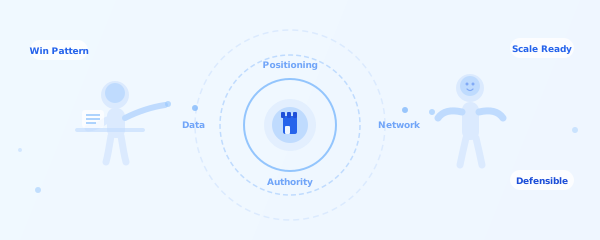
Scaling before you have strategic clarity is the most expensive mistake in B2B growth. You do not amplify your competitive advantage. You amplify your confusion. The MoatMap™ Framework is how we establish that clarity before a single dollar of scale investment is committed.
The Problem With Premature Scaling
Consider what happens when a company scales without clarity. The sales team pursues a heterogeneous set of buyers because the ICP is loosely defined. Marketing produces content that resonates with some buyers and confuses others. The product team fields conflicting requests from customers with different underlying needs. Customer success struggles to define what a successful outcome looks like because it varies by client segment.
Each of these is a symptom of the same root cause: the company does not yet have a precise, differentiated answer to the question every sophisticated buyer is silently asking — why you, specifically, over all alternatives including inaction?
Scaling amplifies the cost of this ambiguity exponentially. You spend more to acquire customers who churn faster, sell at lower prices, and refer fewer peers. The revenue numbers may grow, but the unit economics deteriorate and the business becomes progressively harder to manage.
What the MoatMap™ Framework Does
The MoatMap™ is a four-layer strategic architecture that establishes your competitive position before you invest in scaling it. It is not a marketing framework. It is not a messaging exercise. It is a commercial blueprint that answers four questions in sequence, each dependent on the clarity of the one before it:
- Where do we genuinely win? — Not where we compete, but where we win reliably, repeatably, and at premium prices.
- Why do we win there? — The structural, not circumstantial, reasons for that win pattern.
- What would make that winning position defensible over time? — The investments required to convert a current advantage into a durable moat.
- How do we scale that position without diluting it? — The sequencing of growth motions that reinforce rather than erode the position.
Layer One — The Win Pattern Audit
The MoatMap starts with a rigorous analysis of your best clients — not your largest, not your loudest, but the ones where you delivered disproportionate value, retained longest, expanded fastest, and were referred most enthusiastically. This is your Win Pattern.
Most companies have never done this analysis systematically. They have intuitions about their best clients but not a structural understanding of what those clients have in common — their industry, their growth stage, their organizational structure, their decision-making culture, their most acute problem, and the competitive context in which they found you.
The Win Pattern Audit produces a Precision ICP: an Ideal Client Profile defined not by demographic firmographics alone, but by psychographic and situational characteristics that predict both purchase likelihood and long-term value. The Precision ICP is the foundation on which every other layer of the MoatMap rests.
Layer Two — The Differentiation Engine
Once you know precisely who you win with, you can ask why. The Differentiation Engine maps the structural reasons for your win pattern across five categories:
- Methodology advantage: Do you have a proprietary approach to the problem that produces reliably better outcomes? Can you name it, demonstrate it, and defend it?
- Data advantage: Do you have access to information — through client relationships, proprietary research, or operational patterns — that competitors cannot easily replicate?
- Network advantage: Do your existing relationships create access, credibility, or referral density that a competitor starting from scratch could not build in under two years?
- Brand advantage: Is your firm associated with a specific problem, outcome, or client type in a way that makes buyers seek you out rather than placing you in a procurement pool?
- Speed advantage: Can you deliver outcomes meaningfully faster than alternatives — and is that speed attributable to a structural capability rather than heroic effort?
The Differentiation Engine output is not a tagline. It is an honest inventory of which of these advantages you currently hold, how durable each one is, and which ones are worth investing in to compound over time. Companies that skip this step end up with differentiation that sounds good in a deck but dissolves under the scrutiny of a sophisticated buyer.
Layer Three — The Moat Architecture
A moat is not an advantage. An advantage is temporary. A moat is an advantage that becomes more durable over time — typically because using it builds the conditions for using it again, at higher scale, with less friction.
The Moat Architecture layer defines the specific investments — in people, process, content, data, or community — that will convert your current advantages into structural moats within a 24-month horizon. This requires making explicit trade-offs: which advantages are worth compounding, and which should be maintained at current levels rather than scaled?
Common moat types we see in B2B professional services and SaaS:
- Proprietary frameworks that clients internalize and become dependent on (the MoatMap itself is an example of this dynamic)
- Data compounding loops where each engagement generates insight that improves the next engagement
- Category publication — research, indices, benchmarks — that make you the authoritative source for market intelligence in your niche
- Alumni networks where former clients become advocates, referral sources, and proof points in perpetuity
Layer Four — The Scale Sequencing Plan
Only after the first three layers are defined does the MoatMap address scale. And when it does, it addresses it as sequencing rather than as volume. The question is not "how do we grow faster?" but "in what order should we invest in growth, given the position we have established?"
The Scale Sequencing Plan answers three questions:
- Which channels are structurally aligned with our position? A firm that wins on category authority should invest in content and community before paid acquisition. A firm that wins on network density should invest in referral infrastructure before brand campaigns.
- What is the correct sequencing of market segments? Expanding to adjacent segments before the core segment is saturated is a common growth mistake. Depth before breadth almost always produces better unit economics.
- What organizational capabilities must exist before each growth stage? Scaling revenue without the operational infrastructure to deliver it consistently destroys the reputation that made the growth possible.
Clarity Is a Competitive Advantage
In a market saturated with companies that sound broadly similar, strategic clarity is itself a differentiator. Buyers who engage with a firm that has a precise, confident, well-grounded answer to "why you?" close faster, pay more, churn less, and refer more consistently than buyers who choose you out of mild preference over alternatives.
The MoatMap™ Framework is not a one-time exercise. It is a living architecture that should be revisited annually and refined as your market position evolves. The companies that compound their commercial advantage over time are the ones that treat strategic clarity as an ongoing operational discipline, not a one-time consulting deliverable.
Scale built on clarity compounds. Scale built on confusion burns cash and exhausts your team. The choice is structural, and it starts before the first growth dollar is spent.

Ready to build compounding market advantage?
Let's design a growth system that your competitors can't replicate. Talk to a MoatSquare strategist today.
Start the Conversation